The Weave of Daloy
Record WORLD-002-REVISION
Supernatural phenomena in Kali arise from Ginhawa, nature's living breath, moving as Daloy and shaped through the identity of living beings.
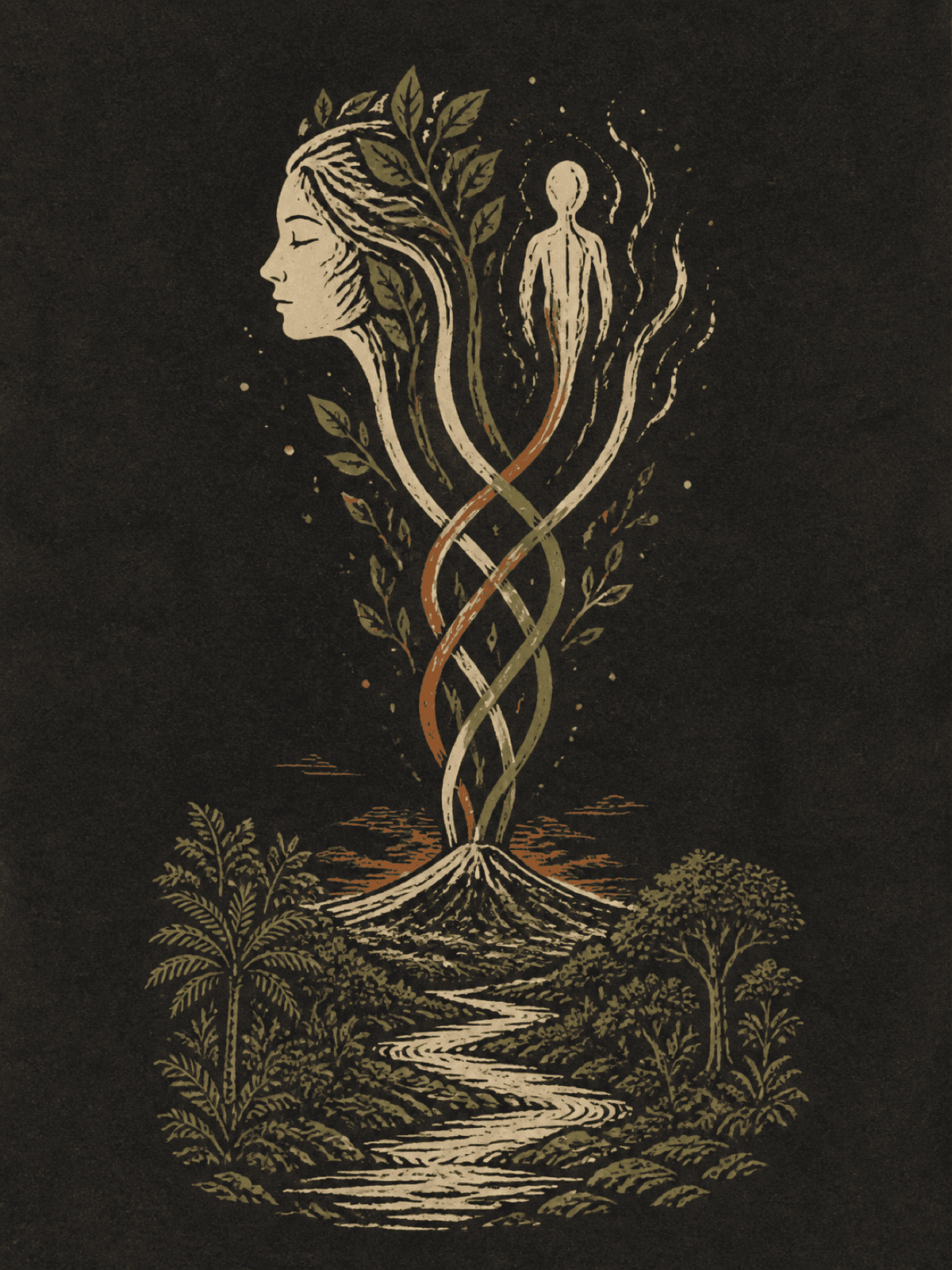
Supernatural power in Kali does not come from outside nature. It is the visible result of the world's living breath moving through places and beings.
Every person can perceive Daloy, just as they can perceive wind. But perception is not mastery. Some people learn to gather and shape it through Habi. Supernatural beings do this instinctively, as naturally as breathing.
The system is built from five connected ideas:
Nature expresses Ginhawa. Ginhawa moves through the world as Daloy. Daloy can be sensed as individual Hibla. A being's Diwa determines which Hibla it can shape. Habi is the act of weaving those strands into an effect.
Ginhawa: the world's living breath
Ginhawa is the living breath of the natural world. Forests, rivers, coastlines, winds, volcanoes, mountains, and sacred places all express it. It is not a spell resource stored in a container. It is a quality of life and activity present in the world itself.
Where nature is healthy and active, Ginhawa can be strong. Where a place is wounded, disturbed, or unusually concentrated, its Ginhawa may behave in unfamiliar ways. These changes are one reason the supernatural can appear in an otherwise ordinary landscape.
Daloy: Ginhawa in motion
Daloy is Ginhawa as it flows through an environment. It moves through water, air, soil, stone, living things, and places marked by long spiritual activity. A person does not need special training to notice it. Daloy can be felt in the same immediate way as wind: a pressure, movement, or presence that is real even when it cannot be held in the hand.
Most people can sense that something is moving through a place. Fewer can recognize its character. Fewer still can gather it and give it a deliberate shape.
Daloy does not always wait for a person or creature to control it. Currents can gather, collide, weaken, or spill into their surroundings on their own. A volcanic region might release a dangerous surge of heat. A river might pull with a force that does not match its depth or speed. A storm, forest, or sacred site might develop a supernatural pattern that changes how people move through it. These are not necessarily attacks or decisions made by a conscious being. They are natural phenomena produced when the world's living energy becomes concentrated or disturbed.
Hibla: the strands within the current
Hibla are the individual strands or portions of Daloy that can be sensed, gathered, and shaped. A practitioner does not seize all of the energy in an environment at once. They draw particular strands from the surrounding current.
Different places offer different qualities of Hibla. A river, a volcanic slope, and an exposed mountaintop may all contain Daloy, but the strands moving through them do not feel or behave in exactly the same way. The environment gives the current its character.
Diwa: the identity that gives power its shape
Diwa is a being's identity, soul, nature, and spiritual pattern. It is the part of the system that determines what a being can weave.
A Diwa is shaped by a being's relationship with the natural world. People who live for generations near volcanoes are immersed in the Ginhawa of fire, heat, pressure, and upheaval. Over time, their communities can develop Diwa that are compatible with fire-like qualities. People shaped by rivers, forests, mountains, storms, or coastlines may develop different compatibilities.
This does not mean that every person from a place will weave in exactly the same way. Diwa is personal. It reflects an individual's identity as well as the environment that helped form it.
Compatibility is a limit, but not always an absolute wall. A person can attempt to learn a form of weaving that does not naturally suit their Diwa, but doing so is extremely difficult and may be impossible in practice. The closer a technique is to the patterns already present in the weaver's Diwa, the more naturally the surrounding Hibla can be gathered and shaped.
Habi: the act of weaving
Habi is the deliberate act of gathering Hibla from Daloy and shaping those strands through Diwa into a supernatural effect.
Humans generally need training to perform Habi reliably. Training teaches a person to notice the character of a current, draw the strands they can carry, and give them a stable form. An untrained person may still produce a basic effect, especially when their Diwa is strongly compatible with the surrounding environment, but instinctive success is not the same as mastery.
Habi is not a universal list of spells. The same current can produce different results depending on the weaver's Diwa, training, intention, and relationship with the place. A technique is not simply taken from the environment and repeated unchanged. It is a meeting between the current outside the body and the identity within it.
How supernatural phenomena occur
There are three broad ways supernatural phenomena can appear.
First, Daloy can manifest through the environment without a conscious weaver. A place with a powerful, damaged, or disturbed current may produce heat, movement, distortion, growth, sound, or other dangerous effects on its own.
Second, a human can use Habi deliberately. Their trained Diwa gathers compatible Hibla and shapes them into an effect. Humans are capable of learning, refining, and passing down methods, but no method can completely ignore the identity of the person using it.
Third, a supernatural being can weave through its own Diwa instinctively. For such beings, Habi is closer to breathing than to studying a craft. Their abilities are not necessarily elemental or human-made. A creature's Diwa may carry a unique pattern that produces behavior and powers no community tradition can fully reproduce.
These three forms can overlap. An environment can empower a creature. A creature can disturb or redirect a local current. A trained human can use a place's Daloy to produce an effect that changes the conditions around them. The supernatural is therefore not separate from the world. It is the world, its places, and its inhabitants expressing different relationships with the same living current.
Corrupted Diwa
Diwa is not meant to be rewritten casually. Forcing a foreign pattern into another being can damage, distort, or transform the identity that was already there. This is an abnormal use of spiritual power rather than ordinary Habi.
A corrupted Diwa may produce supernatural abilities that do not belong to the victim's original nature. The result can be unstable, painful, or increasingly difficult to separate from the being's own identity. The details of this process belong to the lore of the beings who practice it, but the underlying rule is simple: power can shape a being, and a being can also be forcibly reshaped by power.
The complete weave
The system can be understood as one continuous movement:
Nature expresses Ginhawa.
Ginhawa flows through the world as Daloy.
Daloy separates into Hibla that can be sensed and gathered.
A being's Diwa determines which strands it can shape.
Habi weaves those strands into a supernatural effect.
Sometimes the current acts on its own. Sometimes a human shapes it through training. Sometimes a supernatural being expresses it instinctively. In every case, the supernatural begins with the living relationship between nature and identity.